Private-label reed diffusers: choosing a bottle and gift box
A packaging guide for wholesale and own-label buyers: compare diffuser bottles, closures, reeds and gift boxes, then request a complete sample and quotation.

A reed diffuser has two presentations: the closed product a customer buys and the assembled object that sits in a room. A successful packaging brief needs to describe both. A beautiful bottle photograph cannot tell a wholesale buyer whether the stopper fits, the reeds fit inside the box or the finished pack suits the intended shelf.
For private-label reed diffusers, begin with the complete unit you intend to sell. Then compare the bottle, closure, reed set and retail box as one configuration. This guide explains what to measure, what to request in a sample and how to make competing quotations easier to compare.
What recent home-fragrance content can tell a buyer
An Instagram post dated 19 October 2026 in our sample explicitly marked itself as an advertisement and presented reed diffusers alongside room sprays. A TikTok post dated 13 October described home fragrance as a small luxury for the home. These are useful prompts to consider product presentation and the customer's room, rather than scent names alone.
The review covered ten results per platform for reed-diffuser and home-fragrance hashtags. Results included older posts, advertisements and other diffuser formats; audience geography was not verified. This is a small editorial sample, not evidence of a European trend, sales ranking or keyword search volume. For a buyer, the useful question is practical: does the proposed bottle look right both inside its packaging and after opening?
Define the complete sale unit before choosing a bottle
Write down what one retail unit includes. Ask whether the quotation covers filled liquid, a transit seal or stopper, a decorative collar, the full reed set, a label, a box and any insert. A quotation for a filled bottle and a quotation for a boxed gift set describe different products, even when the stated liquid volume is identical.
| Part | Confirm in the brief | Check on the sample |
|---|---|---|
| Bottle and fill | Net content, external dimensions, material, colour and finish | Actual dimensions and the appearance of the intended fill |
| Closure | Stopper or sealing closure, collar and opening method | Fit, removal and the supplier's liquid-pack compatibility checks |
| Reed set | Material, length, count, colour and packing position | Assembled height and how the reeds are secured in the closed pack |
| Retail box | External dimensions, board or box construction, insert and artwork | Bottle movement, opening experience and space for product information |
| Export case | Units per case, dimensions, gross weight and protection | A packed-case reference matching the quoted retail configuration |
Do not confuse a decorative cap or collar with the component that seals the liquid for transport. Ask the supplier to identify each part on a sample or drawing. The finished liquid and pack should be evaluated together; approving an empty glass bottle is only approval of that component.
Compare formats without guessing performance
The XENCER catalogue includes different reed-diffuser presentations. XC-AC003-1 is listed as a 50 ml Jasmine format; XC-AC003-15 is listed as a 200 ml Rose & ebony format. They are useful visual starting points for a brief, rather than proof of current stock or a fixed customisation offer.
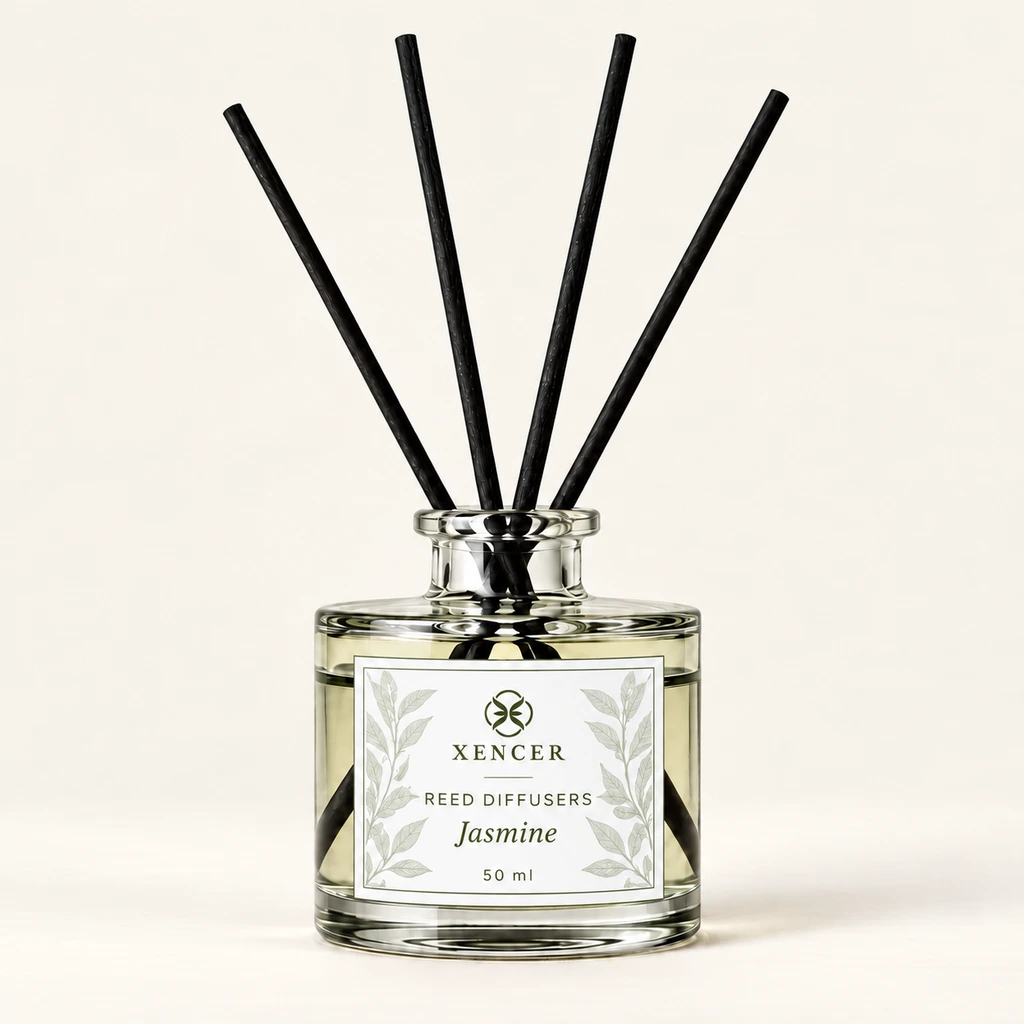
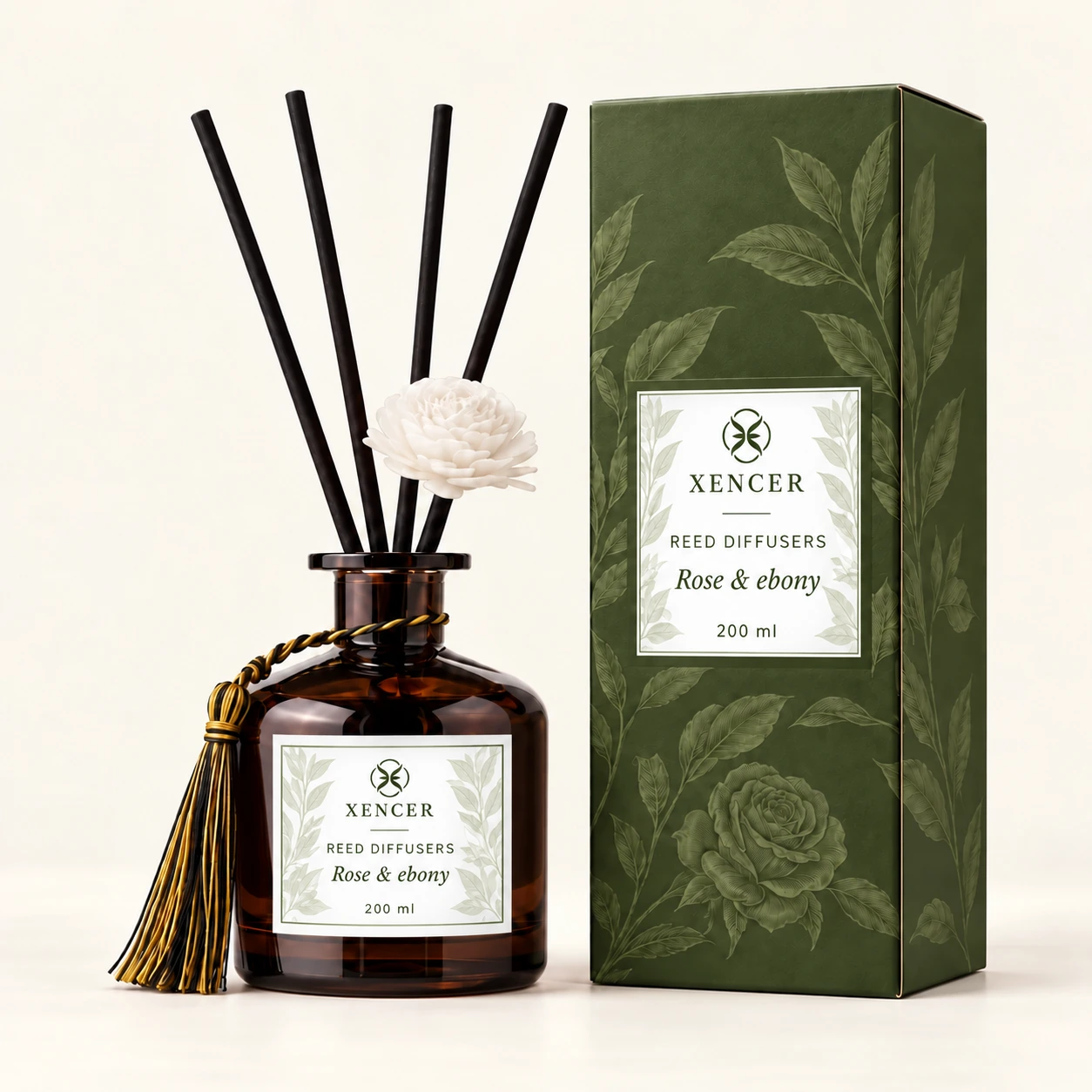
Compare the role of each format in your intended channel: an everyday shelf item, a decorative home accessory or a boxed gift. Record the shelf footprint and assembled height separately. Do not calculate fragrance duration from millilitres alone. Ask for evaluation of the selected liquid, vessel and reeds under stated conditions before using a duration claim in sales copy.
Choose a packaging route before commissioning artwork
Ask the supplier to quote an available vessel with your decoration separately from any proposal requiring a newly developed bottle or box. Request confirmation of component availability, tooling or setup charges, sample stages and minimum quantities for each route. A custom-looking label does not necessarily require a new bottle mould.
Public private-label pages from ODORO describe bottle, reed and box choices alongside prototype development. Ignite likewise treats the liquid, vessel, reeds, closure and carton as connected parts of a project. These are examples of supplier terminology and workflow, not XENCER price, minimum-order or lead-time commitments. Their practical lesson is to approve a defined configuration before final artwork is released.
- Request a dimensioned drawing and printable label area for the selected vessel, rather than designing to a photograph.
- Confirm whether the label, bottle decoration and retail box share the same artwork approval stage.
- Specify where the barcode, product identification and destination-language information will appear.
- Keep the version of the bottle, closure, reeds and box linked to the artwork version, so a component change triggers a review.
Make the gift box work as a pack
A gift box should explain the product, present it clearly and hold its contents in the agreed arrangement. Ask for a sample packed exactly as it will be supplied. Check whether the bottle and reeds are separated, whether the insert holds the vessel and whether the customer can identify the fragrance without opening the box.
Use measured pack dimensions when comparing shipping options. A larger retail box can change case quantity, storage space and freight calculations; a smaller box is useful only if the selected protection and presentation still work. Compare a plain carton, a printed folding box or another proposed gift presentation on the same basis: complete contents, dimensions, packed weight and quotation scope.
Send a quotation request that can be compared
List quantities per fragrance and per bottle design, not only a total order quantity. Ask the supplier to separate product price, decoration, retail packaging, setup or tooling, sample charges and freight scope where applicable. Availability, project feasibility, minimum quantities and timing need confirmation for the chosen configuration.
- Give the destination country, sales channel and intended shelf or gifting role.
- Select catalogue references or provide a bottle reference with target net content and dimensions.
- Describe the closure, reed presentation, label and retail box you want included.
- Provide quantities per variant and request a complete packed sample before final approval.
- Ask which product information, supporting documents and packing checks will accompany the selected configuration.
- Record all approved components and open points before converting the quotation into an order.
Start with the XENCER air-care collection and save the model references you would like to discuss. A clear component list gives the supplier a better starting point than a request for a luxury diffuser alone.