Private-label washing-up liquid: a buyer’s sample checklist
Compare private-label washing-up liquid samples using an agreed dose, cleaning evidence, bottle checks and quotation scope before approving your retail range.

A bottle that looks good beside the sink is a useful starting point for a retail range. Approving private-label washing-up liquid takes more than a colour, a fragrance impression or a short washing-up video. A buyer needs to know exactly what was sampled, how the sample was assessed and which product and pack the quotation includes.
Start with a written brief for hand dishwashing, then ask each supplier to respond on the same basis. The checklist below helps wholesalers, retailers and own-label teams turn an attractive sample into an approval record that can be used when discussing the finished order.
Define the use before requesting samples
Specify manual washing of dishes and utensils if that is your intended category. Do not use dishwashing liquid as a vague label for both hand-washing products and automatic dishwasher products. Ask the supplier to state the intended use of the proposed formula and provide its product directions. Select products and instructions for that use, rather than assuming two formats are interchangeable.
Add the destination country, sales channel and target pack size. Describe whether the intended customer is a household shopper or a professional kitchen buyer. Write down any required fragrance direction, colour preference and bottle format, while leaving unsupported performance or environmental claims out of the initial artwork.
- Intended use and customer: household hand dishwashing, or another clearly defined application.
- Destination country and the languages needed on the proposed pack.
- Target net content, bottle reference, closure style and shelf presentation.
- Quantity per variant, sample quantity and the decision the sample needs to support.
- A list of proposed claims and the evidence you want reviewed before approving them.
Compare samples on a recorded basis
Ask suppliers to identify the sample version, date and intended directions. A development sample, a different fragrance trial and the intended production formula should be distinguishable in your records. If something is provisional, record what must change and what needs to be assessed again.
IKW publishes non-binding recommendations for assessing hand dishwashing detergents, covering plate-based mileage and separate cleaning approaches. The overview emphasises reproducible, relevant comparisons and internal controls. A practical buying question is therefore: which assessment method, comparison product and conditions support the result you have been shown? A catalogue image is not that report.
| Review point | Ask the supplier to record | Buyer decision supported |
|---|---|---|
| Sample identity | Formula or sample reference, version, fragrance and preparation date | Which proposal is being assessed |
| Dose and use directions | Recommended amount and how it is measured for the intended use | Whether comparisons use an agreed basis |
| Assessment conditions | Method, water conditions, temperature and soil / load where relevant | Whether the result can be interpreted and repeated |
| Cleaning result | Recorded observations or report, comparison product and limitations | Whether the evidence addresses the intended claim |
| Rinsing and handling | Observations under the stated directions, plus bottle and closure checks | Whether the overall product suits the intended customer |
| Open points | What is provisional, who will confirm it and which sample must be reviewed next | Whether to approve, revise or request more information |
A visual review can help you discuss presentation and handling. It cannot by itself establish a laboratory performance result, suitability for every surface or a certification. Where a claim matters to your launch, ask for evidence relating to the selected finished formula and agree who will review its relevance to the proposed wording.
Treat dose, foam and rinsing as separate questions
The American Cleaning Institute’s hand dishwashing guidance advises following product-label dosing and explains that extra suds do not necessarily mean extra cleaning. For a buyer, an impressive foam shot should lead to questions about the directions and assessment conditions, rather than an assumption about cleaning value.
Request the proposed dose and the information used to support it. Ask what a quoted concentration or performance claim means for that specific formula. Do not infer it from thickness, liquid colour or the shape of the bottle. If suppliers recommend different doses, keep those differences visible in the comparison.
A simple commercial model can compare price per bottle, net content and the supplier’s proposed dose. For example, dividing a quoted net volume by an agreed dose gives a planning estimate of the number of those doses. It does not prove a number of successful washes: load, method and the evidence behind the directions still matter. Keep this calculation as an internal comparison until any consumer-facing claim is supported.
Check the bottle with the intended liquid
Review a filled pack with its proposed closure, not only an empty bottle. Ask how the bottle and closure have been checked with the selected formula, including leakage and storage or transport conditions relevant to the project. Record whether the label, fragrance or closure in the sample differs from the quoted unit.
- Can the intended user identify the product and follow its directions on the proposed label?
- Does the closure open, dispense and close in the intended way? Ask for the relevant pack checks rather than relying on a photograph.
- What are the filled pack dimensions and weight, units per carton and proposed export protection?
- Which bottle, closure and label version will appear on the final approval record?
- If a component changes after approval, which checks and artwork review need to be repeated?
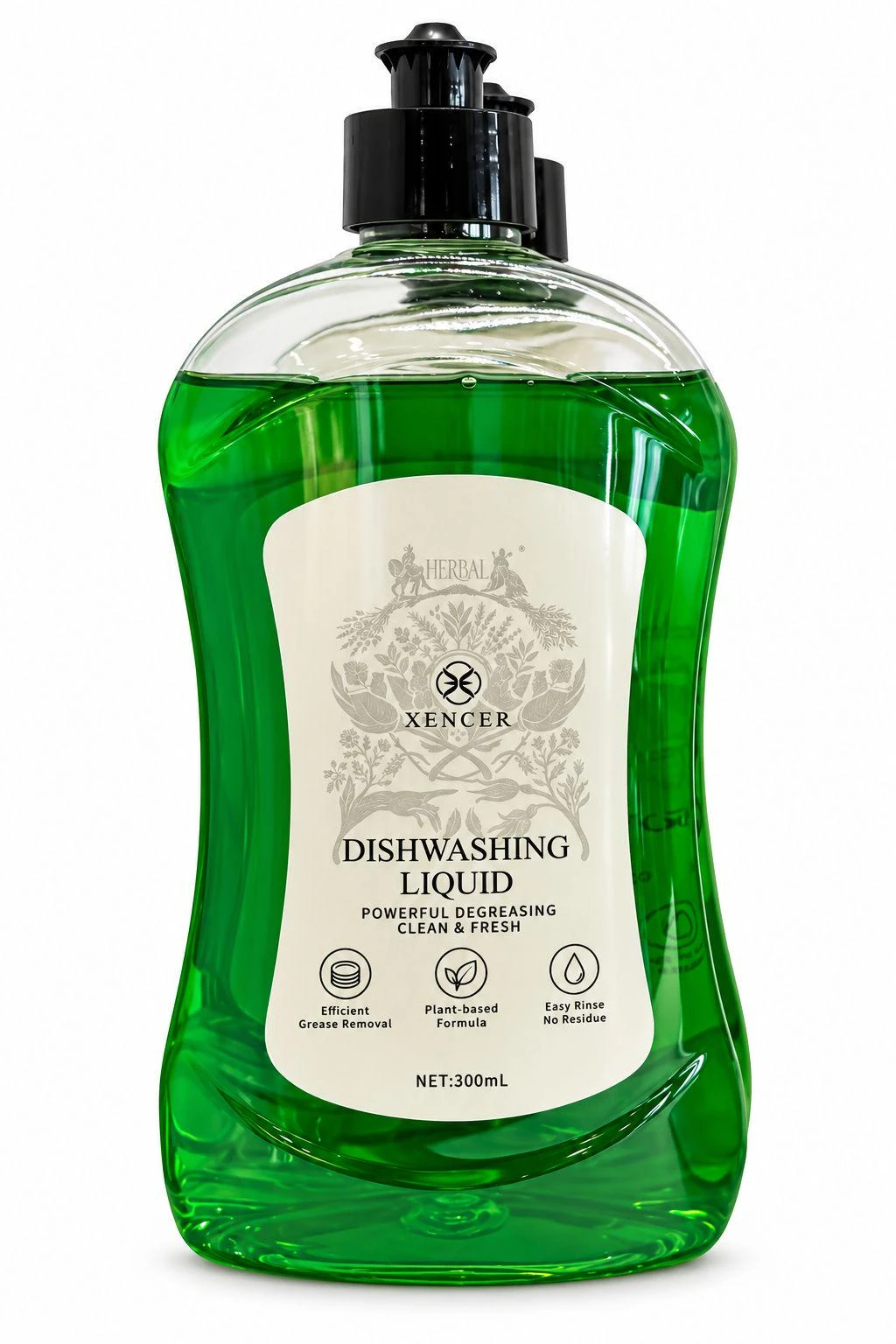
The XENCER 300 ml washing-up liquid catalogue reference can be used to identify a starting presentation for your enquiry. Its photograph does not establish the final formula, a confirmed customisation scope or the evidence behind label artwork. Share the reference with the changes and questions you want the team to review.
Match the quotation to the approved sample
Ask for the quotation to identify the agreed formula or sample reference, net content, fragrance, bottle, closure and label scope. State quantities by variant. A change in bottle size, printed decoration or carton configuration should be visible in the revised proposal rather than hidden under the same product name.
Vipack’s private-label washing-up liquid page describes development, packaging and production as separate parts of a supplier process. This is useful terminology for structuring an enquiry; it is not a statement of XENCER capacity, certification or delivery terms. Ask the selected supplier to define its own proposal and responsibilities.
- Identify the sample reference and list every outstanding question.
- Separate the formula brief from the bottle, closure, label and carton specification.
- Request comparable quantity breaks and state the delivery or freight basis to be discussed.
- Confirm which sample, setup or artwork charges are included, where applicable.
- Ask for the supporting product information relevant to the selected destination and proposed claims.
- Record the approved version and any condition that must be resolved before an order is finalised.
How social topics informed this checklist
Our 4 November review sampled ten Instagram and ten TikTok hashtag results. A 6 October TikTok seller post promoted solid dish soap and refill presentation. An older Instagram washing-up liquid post from 7 April focused on scent. These are different product and promotional contexts. They suggest questions about format, fragrance and evidence; they do not establish demand for a particular liquid formula.
Only one sampled post was within the previous 30 days, and no recent Instagram post was verified. Paid relationships and European audience geography were not established. Search volume and keyword difficulty are unknown. We selected this topic for its buying usefulness and relevant supplier terminology, rather than describing it as a verified trend or popular search ranking.
Send a specific sample request
Explore the kitchen-care collection, save the relevant reference and send your buying brief. A clear sample request makes the next conversation about a defined product rather than an attractive bottle alone.
Sources & further reading
- IKW — Non-binding quality assessment recommendations for hand dishwashing detergents (2024 / 2025)
- American Cleaning Institute — Washing dishes by hand: dose and suds guidance
- Vipack — Private-label washing-up liquid and development / packaging terminology
- TikTok — Own-product solid dish soap promotion, 6 October 2026; contextual sample
- Instagram — Scent-focused washing-up liquid post, 7 April 2026; older background